How it works
A wrong answer is a clue.
A quiz marks 52 − 27 = 35 wrong. RodriMath sees the smaller digit taken from the larger, and teaches tens and ones next.
Free to start · No card · No ads
The short version
Four steps, for every child, again and again.
Follow Alex, in Grade 2, who finds two-digit adding hard.
Find their level
A few questions that adapt find where your child really is. No long test.
Alex, Grade 2: the place to begin is a little earlier.
How it does itKGr 1Gr 2Gr 3Gr 4Gr 5Start hereStarts at their grade and narrows in. A starting point, never a mark. Find the missing skill
When something is hard, it looks for the skill underneath instead of repeating the struggle.
Not two-digit adding. Tens and ones, underneath it.
How it does it- Adding two-digit numbersLooks like the problem
- Tens and onesThe real cause
- Reading numbers to 100Checked first
It walks back, checks what is below, and settles on the cause. Teach it differently
Objects, then pictures, then symbols. A new picture when one does not land.
Blocks, then a tens-and-ones chart, then 34 on its own.
How it does itObjectsPictureSymbolsThe same number, three ways, in that order. Check that it sticks
Learned means still there days and weeks later.
Tens and ones comes back after a few days, then a few weeks.
How it does it- TodayMastered
- Days laterStill there
- Weeks laterStill there
A slip shortens the wait. It does not reset it.
Under the hood
The same steps, as the engine takes them.
Plus what happens when it is hard, and how a question is made. Open any one.
PlacementFind their level
A short start that adapts, not a sixty-question test. A starting point, never a mark.
It reads more than right and wrong: a hint asked for, the time taken, a not sure.
A short start, in three passes
- Roughly whereA handful of questions around their grade, narrowing each time.
- Which areasA few questions in each area of mathematics.
- Which skillsA closer look only where an area came in low.
Broad, then closer, then only where needed. A strong child is not made to prove it sixty times. PrerequisitesFind the skill underneath the struggle
Every skill knows which skills come before it, so a difficulty is traced back to where it really starts.
When a child struggles, the engine walks the map backwards: is it this skill, or the one underneath?
A teacher sees that walk as a sentence on a child’s page and a lit chain on the map. Where it is guessing, it checks with a few questions first.
The walk backwards
- Adding two-digit numbersLooks like the problem
- Tens and onesIs the problem
- Reading and writing numbers to 100Checked first, then taught if needed
Traced to its cause. Where the engine is guessing, it says so and checks before it reteaches. 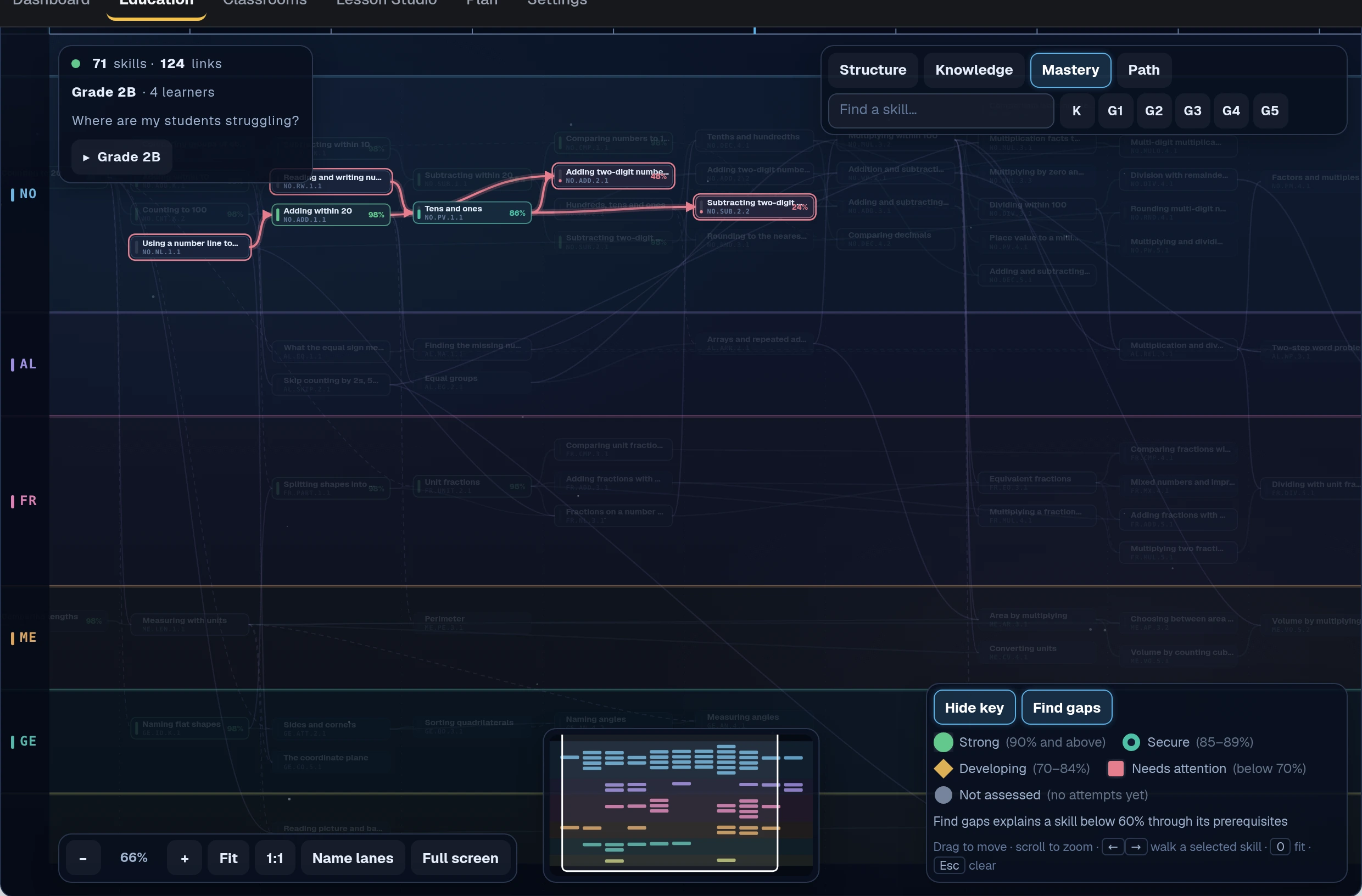
The skill map, coloured by one class, with the chain behind its weak spot lit. Concrete, pictorial, abstractTeach it with objects, then pictures, then symbols
A child builds a number before they read it, and reads it before they write it.
- Concrete: build the number with blocks.
- Pictorial: read it in a place-value chart.
- Abstract: see it as symbols alone.
A session is fifteen to twenty-five minutes and ends with a choice, not an obligation. A hint is always there; no lesson, check or test is timed.
The same idea, three ways
ObjectsPicture3 tens + 4 ones = 34SymbolsObjects, then a picture, then symbols, in that order. 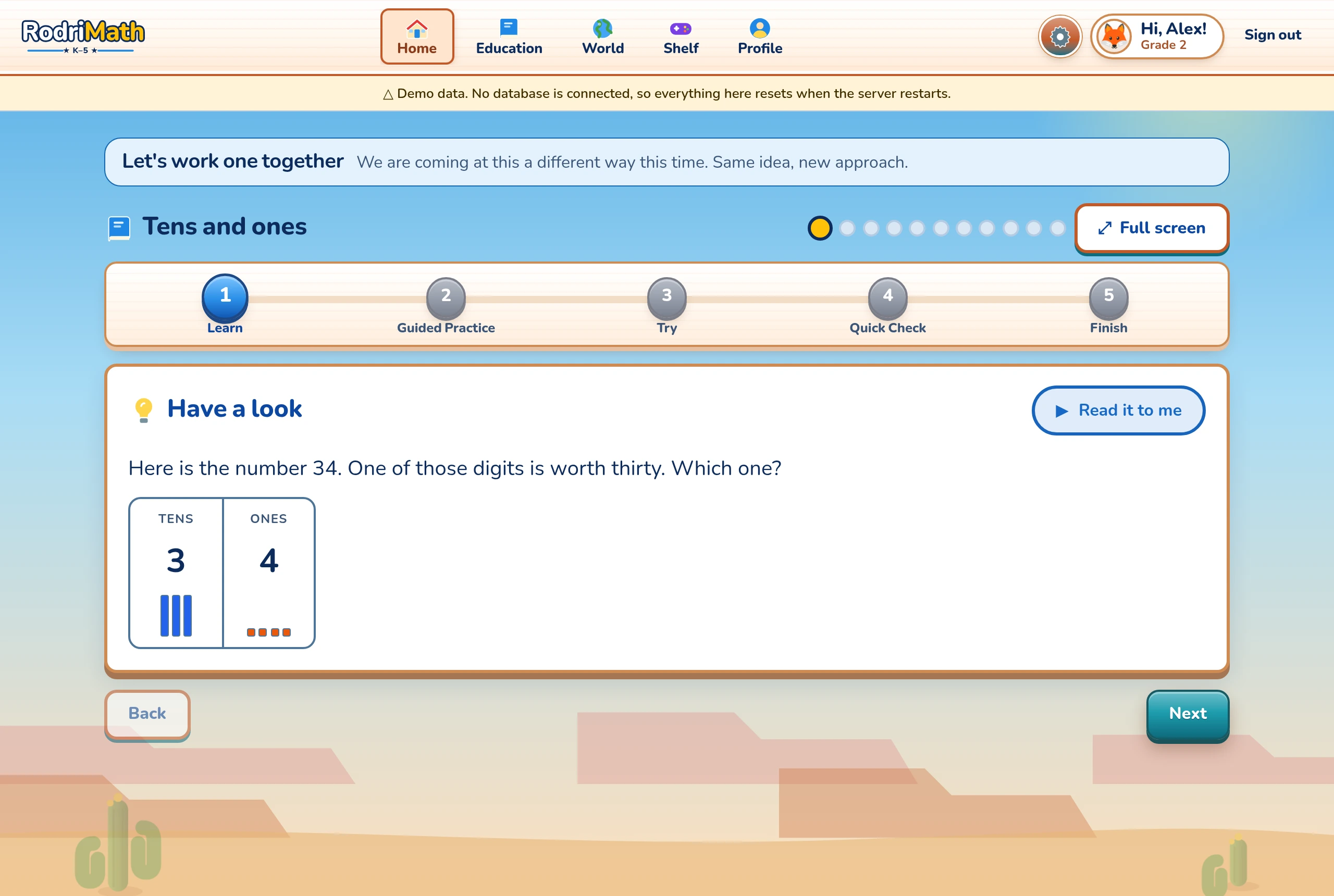
A lesson’s first step. Pictorial, with the blocks drawn. 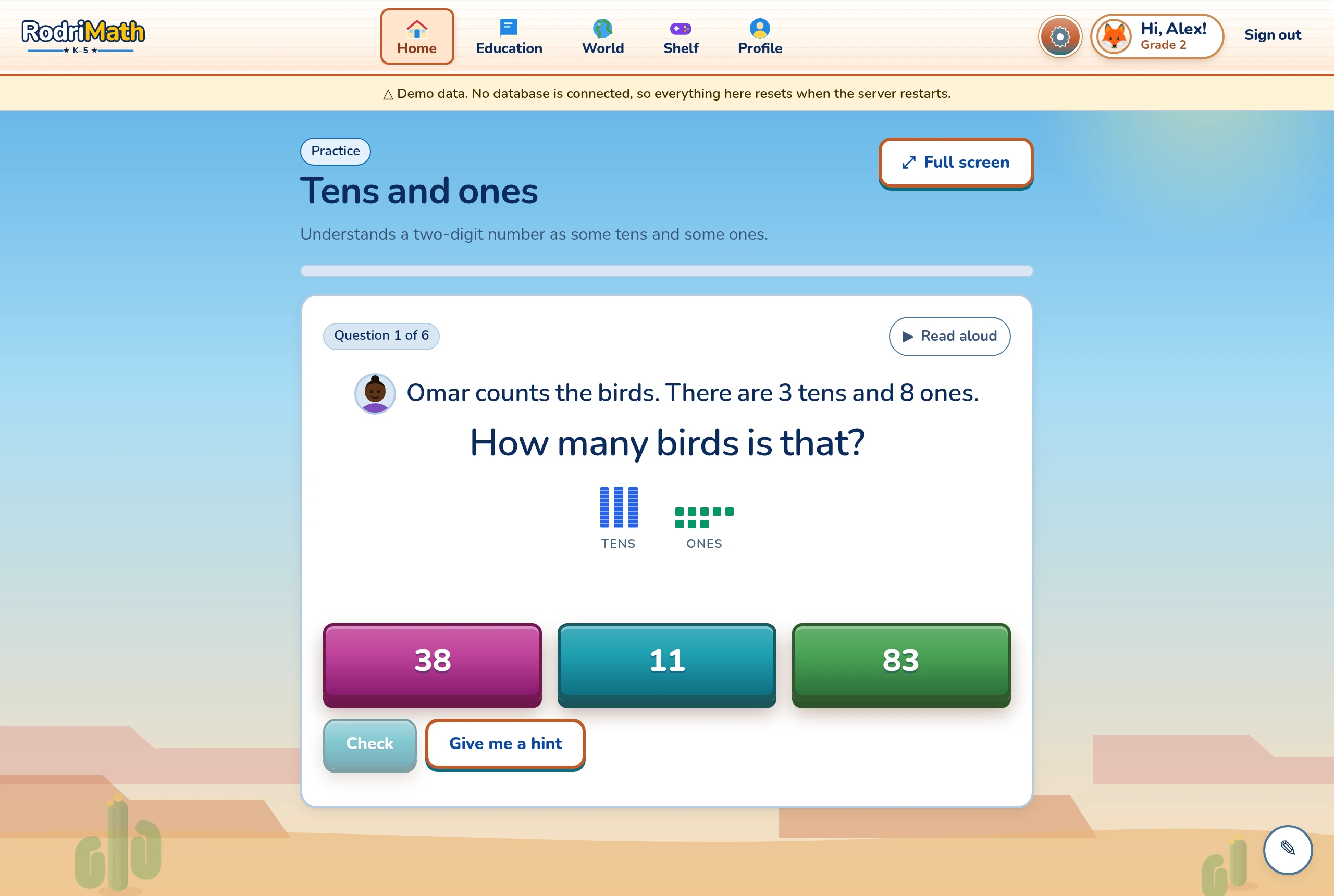
Guided practice, with a hint offered and taken. Alternative approachesWhen it is still hard, change the picture
The same question is never served twice. When the approaches run out, a person is asked in.
Each try changes what the child is looking at, one rung at a time.
When the approaches run out, it stops and tells the teacher rather than inventing another variation. That is the moment a person is needed.
When it is hard, the picture changes
- Let's look at a picture
- Let's build it
- Let's work one together
- A smaller version
- Try this one
- Somewhere new
- Show what you know
Never the same question again. Each rung changes what the child sees; the last is a person. The mastery standardMastered means five things, not one good day
Right now, still later, more than one way, somewhere new, and nothing wrong left underneath.
Nine out of ten is not mastery. All five must hold at once, and a teacher sees which is still open.
Below the standard are bands, and none is a wall. A child is never blocked.
Mastered means all five
- Right now. Answers it well on current work.
- Still, later. Got it again on a check days or weeks afterwards.
- More than one way. With objects or a picture, and in symbols.
- Somewhere new. Used it in a problem that was not the one practised.
- Nothing wrong underneath. No misconception about it left unresolved.
A good score on the day is only the first. A teacher sees which is still open. Beneath mastery there are bands, and none is a wall
Needs reteachingBack to what is underneath, with a new picture.DevelopingTargeted practice. Never blocked.MasteredA check is scheduled for later.StrongHeld, and used somewhere new.Below the standard, a child gets what is underneath or more practice, then is checked again. Delayed retentionCheck that it sticks, weeks later
Every mastered skill comes back, days and then weeks later, inside ordinary practice.
The gaps stretch as it holds, and never so far that a concept goes quiet for good.
A slip shortens the next wait; it does not reset it. Families see it as came back to it after a few days.
It comes back
- MasteredRight now, five ways.
- Days laterA quiet check inside ordinary practice.
- Weeks laterAgain, further out. A slip shortens the wait.
- Months laterStill there. That is what mastered means.
The wait stretches as it holds. If it faded, it was not mastered yet. How a question is madeEvery question is checked before a child sees it
Written by a person, generated within bounds, every answer worked out twice, and approved.
Every wrong option is a real misconception, so a wrong answer tells the engine what the child believes.
Every item can be rebuilt exactly as the child saw it, so a teacher can look at the very screen they answered.
How a question reaches a child
- A person authors itA template, signed off.
- A generator varies itUnlimited items inside its bounds.
- The answer is proved twiceTwo independent routes must agree.
- A person approves itAnything that fails a check is never served.
Not written live by a model. Authored, varied within bounds, proved two ways, approved by a person.
What it is not
Three things the engine will not do.
- Let anyone write mastery. Not a teacher, a parent, an administrator or us. Only the engine, from what the child did.
- Measure time as a target. No session lengths, streaks or daily-active counts. Only what was learned.
- Keep a child on a failed question. The picture changes, and when the approaches run out, a person takes over.
See it from your side
The same engine, three readers.
For families
What your child is working on, and one thing that helps at home. The page for families.
For teachers
Who needs you this morning, and the lesson on the board. The page for teachers.
For schools
One upload, one list, one price, one afternoon’s privacy review. The page for schools.