Mathematics · Kindergarten to Grade 5
Math that meets your child where they are.
It finds the problem underneath the mistake, teaches it a new way, and checks later that it stuck.
Free to start · No card · No ads
- Two-digit additionLooks like the problem
- Place value · tens and onesIs the problem
- Counting to 100Mastered · held 3 weeks
The diagnosis points at the cause, not the symptom.




In children’s own words
Every wrong answer has a reason.
Children rarely guess — they follow a rule. RodriMath knows 237 of them.
In each column I take the little number away from the big one.
Eight is bigger than four, so one eighth is bigger than one fourth.
Whichever one sticks out further is longer.
The bigger coin is worth more.
The times sign is another way of writing plus.
A shape can only have one name.
I add each column and write down whatever I get.
Add the tops and add the bottoms.
A bigger drawing is a bigger angle.
You round by crossing off whatever is on the end.
To find how many altogether I have to count them all.
It is round, so it is a ball shape.
Rows and columns are the same thing said two ways.
If I run out of ones I just write zero and move on.
See it in action · one minute
Most apps mark it wrong. RodriMath asks why.
Answer like a child might, and see what RodriMath does next.
A Grade 2 question
52 minus 27 equals what?
Tap an answer — wrong ones too.
Try 35: it is the answer children give most.
One product, three doors
What brings you here?
For my child
What they understand, what is underneath, and one thing to do at home.
What it does for familiesFor my classroom
Know before the bell who needs you, and why. One class of 30, free.
The teacher’s experienceFor my school
One September to roll out. An afternoon for the privacy review.
Rollout, privacy and pricing
It knows where to start.
A short start that adapts finds what they can really do.
613 skills on one connected map
It knows why they’re struggling.
It traces a wrong answer to the idea behind it, and teaches that.
237 wrong ideas it knows children hold
It knows whether it stuck.
Skills come back weeks later. Mastered means it still holds.
665 lessons, K to 5
The real product · Monday, 7:50 AM
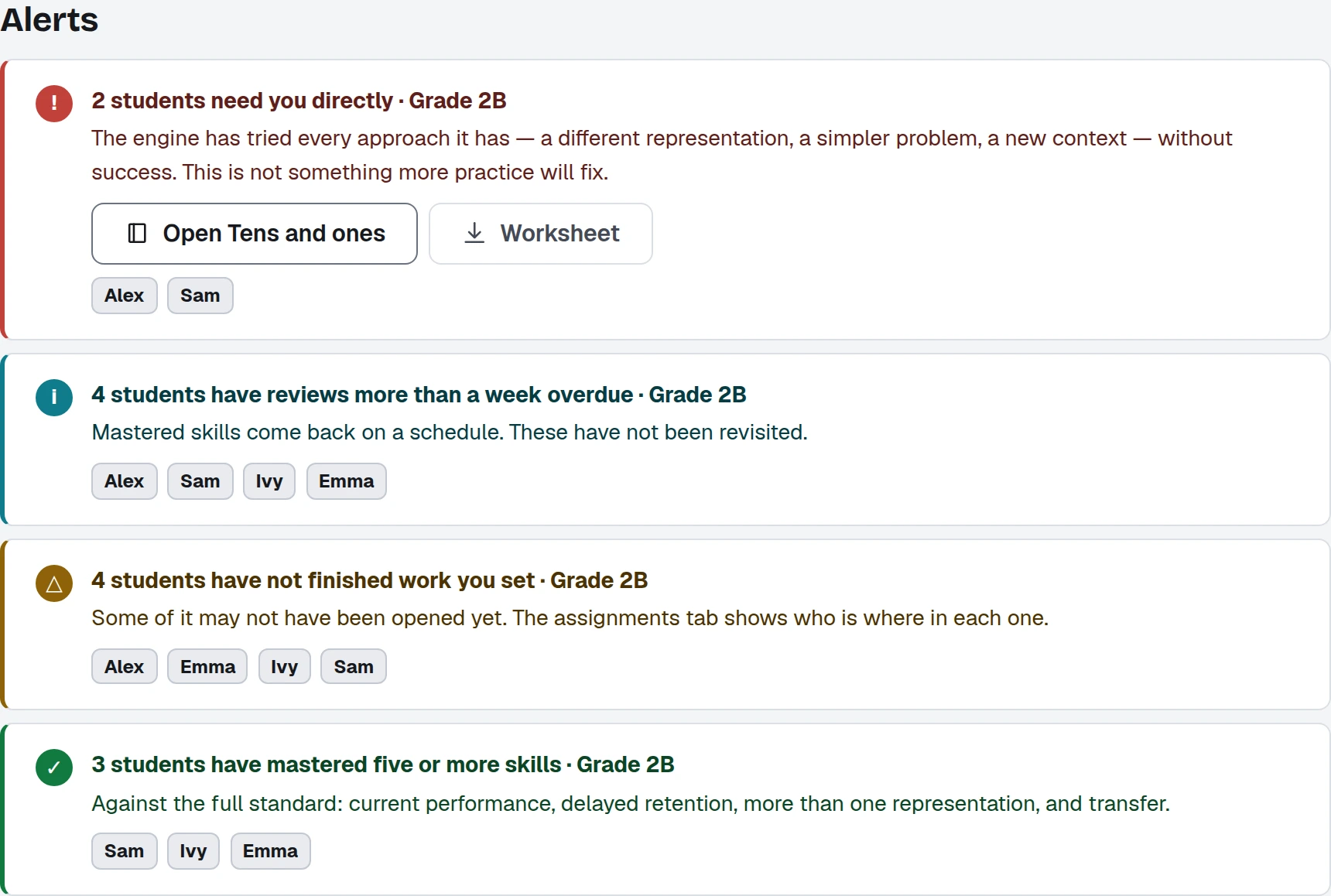
Before the bell, it already knows who needs you.
Who is stuck, why, and the lesson that fixes it.
- Who needs you
- Why, in one sentence
- What to teach, ready for the board
- Who to group together
Two sides, one product
A world for the child. A clear picture for the adults.
The child sees a world that grows up with them. The adults see what it understood.
The child
Learns, plays, answers
- Playful Grades K – 1

- Adventurous Grades 2 – 3

- Sophisticated Grades 4 – 5

No timed lessons, no daily streak, no score against another child.
RodriMath
Understands the learner
- Where they really are
- The skill underneath a struggle
- What to teach next, and how
- Whether it stuck
The adults
See it, in plain words
- Parent — what they’re on, and one thing for home
- Teacher — who needs you, why, and the lesson
- School — every class, one audit trail
The curriculum · Kindergarten to Grade 5
Six years of mathematics, one connected map.
Placed by what they can do, not by their year.
Kindergarten
Numbers to 10, shapes, comparing, number pairs, counting to 100.
65 skills · 65 lessons · 6 modules
See the year →Grade 1
Sums to 10 and 20, place value to 120, length, shapes.
92 skills · 93 lessons · 6 modules
See the year →Grade 2
Sums to 1,000, place value, early multiplication, money, time.
84 skills · 83 lessons · 8 modules
See the year →Grade 3
Multiplication and division, fractions, area, measurement.
138 skills · 138 lessons · 7 modules
See the year →Grade 4
Multi-digit arithmetic, fraction operations, decimals, angles.
126 skills · 153 lessons · 7 modules
See the year →Grade 5
Fractions with unlike denominators, decimals, volume, the coordinate plane.
108 skills · 133 lessons · 6 modules
See the year →
Designed for every learner
Every child can make it work for them.
Every setting is the child’s own, and works at once.
- Read aloudAny question or lesson step, spoken.
- Text sizeFrom 70% to 200%, the layout with it.
- High contrastFor every screen.
- Reduced motionStops every animation.
- Dyslexia-friendly typeWith looser spacing.
- No rushRemoves every timed element.
- Simplified visualsOnly the mathematics on screen.
- Keyboard answersNumber keys, and every control.
Privacy and trust
Built for the child, not for the metric.
A child’s record holds no email, birthday or location — and has nowhere to put one.
- No ads
- No tracking
- No leaderboards
- No nagging
Pricing
Every price is published.
Start free. No card, and nothing to buy inside.
Families
$99
a year for the first child — about $8.25 a month
- 30 days free
- No card to start
Teachers
$0
for one class, with no end date
- Up to 30 children
- No card, ever
Schools and districts
From $8
a child a year, on one published ladder
- Every child covered
- Teachers included
Before you decide
Six questions, answered straight.
Is it a game, or is it school?
Both. A real K–5 curriculum, inside a world a child wants to be in — with no leaderboard, no streak that punishes a missed day, and no timed lesson, check or test. A few games have a clock for fun, and “No rush” takes it away.
How long is a session?
Fifteen to twenty-five minutes. It ends with a choice to go on, never a demand.
Does it replace the teacher?
No. It finds what a child is missing and hands the teacher the lesson.
What does it collect about my child?
- Held: a first name, a username, a PIN, a year group, their character and their answers.
- Never held: an email address, a date of birth, a location or a device identifier.
Everything else is on the privacy page.
What does it cost?
- Families: per child, after 30 days free.
- Teachers: one class, free for good.
- Schools: per child, on one published ladder.
Every figure is on the pricing page.
Can my child use it at home and at school?
Yes, on one account. If the school pays for a child, they need not be on the family’s plan.
Find the real problem this week.
Free to start. No card, nothing to install.